Monday, February 23, 2009

"Pasi-aw ni Pastor Ed"

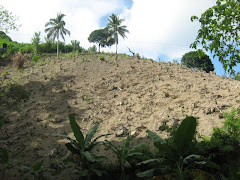
To this young man named Julie, I am always “Pastor Ed,” and he would not listen to corrections. With him and his wife, I had much time to study the Word. They had scant time to sit down with me in their home but they were good listeners, observing and absorbing everything they heard from me. Both spent much time in the pechay patch that Julie had carved out of a mountainside. Sometimes he would drive a motorcycle-for-hire, taking passengers on pleasure trips to Mount Manunggal, but always you would find Julie and his wife in their garden patch. It was there too that I would conduct my Bible class.

Slender and somewhat tall, Julie’s moods and ways may swing with his environment, including its sadness and its pains, but he has always believed that laughter is the best medicine even for back-ache. And it seems both of us and those who join our circle never get older day by day.

A year ago he put an end to his life as a pechay planter. Business had not been good and the weather had been so unkind. So stop planting. Diversify. Then I saw him tending sheep and goats owned by one rich man. And so amidst the cacophony of bleating goats and blah-ing sheep, we put finishing touches to a dream by putting an end to that dream—the vegetable truck farm we had envisioned over cups of coffee during days and nights of rain that detained me in this mountain lair never saw reality. You are now a pastor of goats and sheep, I said. That’s good.

I encouraged him to get a license to drive; he did. I urged him to learn driving a jeepney and he became an expert in it.

And so the dreams of youth that I had and which I laid out before Julie’s eyes became his dreams too. His wife underwent training to become a sewer of ready-to-wear garments. Then he told me his wife had been accepted to work in a garment factory. I said good. That means she would stay in the city and you’d remain in this mountain lair of yours– far from the madding crowd, far too from the economy that moves. “She would be working seven days a week with half of a day of rest,” he said, “and that rest is not on Sunday. And she would be allowed to come home only once a month.” Wow, how can you manage that? I asked.

Listen, I told him. These are trying times. The city is full of lights but there are sons of darkness prowling in its every corner. These will try your souls; these will try your marriage too, if it is meant to survive. Both of you are still young– she’s 19 and you’re 22. And remember, you have a pretty woman for a wife. Take good care of her, and that takes care of your marriage.

Last Sunday I was back. I was told that Julie’s wife is now on her first day on the job. But Julie and his daughter too were nowhere to be seen. Where are they, I asked. “He resigned,” Edward said.

And Edward told me why: It is because of the “Pasi-aw ni Pastor Ed” (”The joke of Pastor Ed”).

What I said about his wife and his marriage set Julie into thinking. It was not meant as a joke.

The family is now in the city. He’ll drive jeepneys if not tricycles, and he would be near her– to keep their marriage intact.

"Tata"

Tata. That was how he was introduced to me. In Ilocano, he would be “Balong.” In Cebuano, he would be “Dodong.” He is an Ilonggo from South Cotabato. “Tata” literally means “little child.” When I first met him, he was 27 years old, married, and had a baby of his own named “Toto,” “little boy.” Tata and I speak the same dialect. His parents were from Negros Occidental, the province whose name to me often evokes nostalgia.

Tata’s wife is named N, and she’s from this side of the mountain where I go in and out preaching the Word. From his story I surmised that she was a woman full of ambitions.

Theirs was a whirlwind romance. He started courting her one day when their paths met. He was tired and thirsty and she guided him to that nook behind a forest where a bubbling spring could be found. They began a conversation that lasted until noon. He was struck by the beauty of this mountain lass, with her features so fine she could be mistaken for an “hija bastarda.” It never occurred to Tata that while they both shared the same attraction, they would never share the same faith, or dreams, or goals. After a week of courtship, she became his wife.

I had studied the Bible with Tata many times. He listened, understood the logic underscoring the teachings of the Scriptures, and began to see the light. After a few months, he was on his way to become a disciple like the one he reads about in the Bible. Tata lacked just one thing. But then I was ready to immerse him– if he was ready too. He said he was.

Tata’s wife got herself a job in the city, first as a lady security guard for a grocery store, then as a factory worker at MEPZA. At the time we were having studies, his wife had already been away for a month.

Tata never came to the baptismal pool as scheduled. His wife had left for a job which she thought was good as far as economics was concerned, but she also left him for another man. He was so downhearted.

I saw him again three months after. He came for advice. In the kindest way possible, I frankly told him three things that were wrong.

First, He had fallen in love with a woman who was not even in love with him. Love in a marriage is a two-way traffic. She was a Delilah in disguise. You remember that Bible story.

Second, their home started in the wrong nest. After their wedding, her parents’ home became their home. What does the Word of God say about spouses leaving parents and cleaving to each other alone?

Third, their marriage was without any moral foundation. Tata strived to listen to Jesus and obey Him; his wife never had a qualm about doing anything immoral.

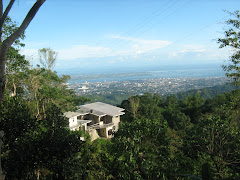
It’s been three years since Tata and I last saw each other. He’s back in South Cotabato, trying to pick up the pieces of his life and restructure it. I miss that friend of mine, even as I pass by a big mansion on my way out—another imposing structure in this forest land, where Tata’s ex-wife now reigns as queen. The cost? Just three million pesos. Built for her by her new lover. She was twenty-five. He was sixty-five.

Tata, on the other hand, found the church in South Cotabato.

My Grandson

What is it about this little boy, seven years old, who keeps me wanting to have him always by my side? We never invited him to be a part of the family; we never expected him. But he came anyway.

And we love him. Oh, how we love him! Never a day would pass without us in the family expressing this heartfelt emotion toward him and embodying that emotion with acts of love. It is not just money and toys, it is money and toys wrapped in tenderness. It is not just McDonalds and Jollibees, or electric train, or the colored TV; it is these that when attached to the act show that he is the most loved persona in the household.

And so he holds that special place. He is not content of me being just his grandfather, he wants me take on the role of the man whom he saw only once or twice in his life, the father he wants to be with but never wants to see. We in the family always wish the boy well. And in our wish, we desire that he will turn into something still lovable in our eyes. For is it not, that when a man grows old, he either grows into the most hated man or the man most loved? We wish him to be the man we always desire to be, but have not been. And that desire moves us to have him turned into a man who will have a healthy respect for the father he never misses.

We will, that he too shall become a man who is never afraid of his past. For his past we have accepted, as we have accepted ours.

We will too, that in these times when some morals are bankrupt, he shall be filled with it; that he will grow up as a God-fearing man, a lover of good, a promoter of what is best, a persevering fellow who keeps toiling in silence and in the midst of difficulties when others may do it in pomp and in ease.

We will, that he shall not be a lover of money and favors, and that he shall disperse of these only to the deserving and the needy.

It is the grace of God that favors his arrival into this world; and it is that grace that has changed our perception of family. Begotten by the daughter who is the apple of our eye, his coming has changed us all. We wish that he will not change as the most lovable boy the Lord has ever gifted us.

His name is Charles Jacob, and if you ever have a chance, I want you to meet him too.

One Incident in the Past

Talk about high school. What does one remember about it? I don’t put mine in the class of the Very Significant, or the Very Memorable. Others recall theirs with sadness or with joy; mine with the lesson that it has brought me.

That noon time of my last year in high school was just like other noon times of my life. I was sitting there under a kaymito tree behind the school library. It was no ordinary tree, as far as I am concerned, for it was the biggest, the tallest, and perhaps the oldest kaymito tree in the whole village. Its crown had withstood many tropical storms of history. Nobody ever thought of cutting it down even to give way to the walls being built around the school’s property. For that tree was part of the will on the property deeded to the school. And so it stayed.

And so I also stayed. Hiding behind the lowest branch that stooped like an arch, I sat under it. I was there munching the ripe fruits that I could lay my hands on. It was the best lunch I had ever had, since nobody was watching, and nobody saw what I was doing. Or so I thought.

Except that I heard some steps. Someone grabbed me from behind, and pushed me to the ground. There he was: the teacher of my terrifying dreams. Playing the role of safe keeper of the olden kaymito.

What followed was the usual. This was not my first time to be brought to the office of the principal. I was his greatest quarry, the top guy of the graduating class, caught with his pants down.

Never mind if the principal had forgiven me. Never mind if I only got a warning. The principal understood the plight of the poor, he having been a poor scholar himself subsisting on the fruits of the tree he had never planted. He knew that the only lunch I could get in those days of poverty was kaymitos. He forgave me. But the safe keeper of the olden kaymito did not.

In the years that followed I became a searcher of truth. I searched for the meanings of want and bounty, why some people had it more while others had none. In my search for truth, I also found God. As a minister of the gospel, I also understood why people acted so and so.

I had been back to the village school one time. The safe keeper of the kaymito was at his yard, stooped by years of service. The principal was not, for I saw his tomb that day. But he made it known to all before he left, that no one should ever be denied of the fruits of any tree in the school grounds, especially if he is hungry. The safe keeper of the kaymito understood it too late. But now he was smiling at me.

Monday, November 3, 2008

Frustrations

My heart bleeds in pity for the low state she is presently in–a woman sick of an ailment she thought incurable, without any money, without any friend, forsaken by kids, left to rot by relatives.

She was special. She was special in more ways I could think of, and that was before. She was the first person who heard me preach in this part of nowhere, the first to ask me to share dinner with her and her family in the dilapidated shack she calls home, the first to invite neighbors to listen to me preach. I could relish with joy preaching to a big crowd who came because this woman took it upon herself to challenge their faith and tell them in her laywoman’s tongue the original Jesus she had heard me teach. Come and listen and be blessed, she would say.

She too was the first to accept the gospel invitation when it was extended. And as I lifted her up from the watery grave that was Talamban church baptistery, she exuded with much joy.

Her admirable virtue was her propensity to believe what I was preaching about the God of the impossibles: “Though your sins be as scarlet, God could make them white as snow; though they be red like crimson, they shall be as wool.” She would repeat this as she heard it from me. Of course, she like the rest of us has seen no snow, and neither does she have any idea how wool looks like, but she took all of it. She needed that message. When others doubted whether such non-Catholic theme makes sense in this community that was shackled by the influence of an adulterous priest, she negated that with all her might. She was not afraid of that priest, and neither should you! She could be the first woman heretic in this mountain heartland. She didn’t mind that.

That was eight years ago.

Her spiritual journey after her baptism was one of many rises and many falls. Many absences from worship. Much quarrel with husband. Her daughter complained of her being unmotherly. She, the mother, complained of her daughter’s being disrespectful. Daughter and mother would have a showdown in front of me during a session, their way of engaging my sympathetic ear for their cause. I did not know what to believe.

Now I know why. I was not able to convert any of her kids. Not even her daughter-in-law. She was too much for them, and she was not helping the cause of Jesus.

She definitely has changed. And she has changed a lot.

I pity her seeing now this state she is in. The other part of me however hates her distrusting disposition. Do I say distrust? While she claims she is still a believer, she displays hints that she no longer is.

I have been trying to explain matters to her, like I was explaining to her last week, matters of how God cares for His own, how God could move people and events to help His people. Be patient and wait. I am trying to find help for your illness. This is no age of miracles; these are times of God’s providence. Miracles come in an instant. Providence may take a long time.

She baffles me by asking why God can’t help her immediately? There is a reason, I’d say, and that is you. That is sin in our lives. I have asked her to be transformed firstly by renewing her disposition. Be a likeable one among these people whom you do not like. Be patient. Be Christ-like. Be hopeful. Be trusting.

You perhaps could sense as you read these lines that the preacher in me has been trying doubly hard to put some sense into the brains of a stubborn woman, and in my way of doing, I was cramming many things into her. These are the lessons she missed by not attending the classes. My desire is for her to regain the ground she has lost, ground she has been losing, ground she is about to lose. I keep harping on it by asking her to try more faith, more hope, more patience and endurance. I ask her to wait for God. The Lord in His own time will answer your prayers.

She argues with me. “No more,” she snaps back. I can’t believe that!

And when she utters something that I thought I would hear only from infidels, I in my frustrations have no options but to leave.

She is holding a bolo, a sharp machete that could cut me in pieces. But that definitely is for someone else–for the husband she says she has shared this miserable life of thirty-five years. She hates him so much.

Her husband? He keeps company with us at church. He now learns to pray and lead the prayer. “Are you going to kill the man who loves you, the man who has forgiven your acts of betrayal in the past?” That is frustration in me speaking to her, my voice perhaps louder than loud, and you could sense that. I better go!

This morning worship service goes on as usual–without her, of course.

After church I take the husband aside and warn him to be careful. He nods his head. He knows too well.

I still love this woman disciple who was the firstfruit of the Lord’s work in this place I call nowhere, in this mountain heartland. I could not bear not doing anything that could perhaps help her regain her first love. Not giving up? You bet I am not.

Today I have left some money with the church treasurer, with the instruction to help this woman–this disciple whom Jesus also loved like the rest of us.

Love has no dimension, as I would often tell them. Love is vaster than the vastest sea, deeper than the deepest depths. The whole of heavens cannot contain it. It is loving the unlovable and the unloved. It is loving in spite of, or despite of. That is the love of Jesus. We can only emulate a part of it, but not the whole of it.

If you by chance have that feeling that you have given all to help and that your generosity has been abused, that the disciple who once believed in you no longer believes in you, be of good cheer: You are not alone.

She is sick and suffering. But it is a sickness that is more than physical. And as I pass by her house on the way out of the village, I have been told that she is still holding that bolo and waiting for her husband to come home. She has threatened to hack him, and then she will commit a harakiri.

If this happens, then I could write FINIS to a chapter of my frustrations over a disciple who once was and now no more.

But deep in my heart I still long for this lady to come back. And I have asked the church to help me pray for her.

Saturday, September 20, 2008

Not Everyone Can Be Us

The preacher eagerly doing the job of preaching has certain challenges, opportunities and responsibilities. These I describe as peculiar; others call these extraordinary. They are a part and parcel of a preacher’s private life that makes him tick— his study life.

The preacher must be a well that doesn’t run dry. It is an axiom that dry wells cannot give forth water. Brethren will long to come to free-flowing springs to have a drink. The fruit of much study comes out of a preacher’s mouth, but the seed of scholarly efforts must first be planted in his brain. We cannot teach what we have not imbibed.

In other words, a preacher must needs to have mental industry, or he would amount to any of the following: (1) Producing boring, haphazardly-done lessons in the category of the mediocre. (2) Calling on another preacher to save him— that is, to do the preaching for him. (3) Coming up with a false doctrine. (4) Falling short of the congregation’s expectations, he may resign his job.

Our skull is so arranged that it cannot be opened or unzipped or detached and tons of much readings deposited in it, like cash in a bank. The royal road to learning is still by learning the hard way, putting the brains to work by burning the midnight oil. The congregation’s second nature is to demand more of its preacher than of itself, so a preacher is a cut above his fellows. That includes the area of knowledge.

You may have often heard shallow, repetitive preaching. This is boring, tiresome and inexcusable. The preacher and the congregation he ministers to is no firmer and more edified than what he consumes and correspondingly feeds the congregation each God’s business day. God’s complaint about His people’s leaders in olden times (“My people are destroyed for lack of knowledge,” Hosea 4:6), is also an indictment against us in these modern times. A malnourished congregation is bound to become a driftwood.

The above observations simply emphasize the indispensability, importance and need of the preacher to be a serious student of the Word. Listen: even an inspired man must needs to find time to commune with his library no matter how meager. Go back to some scriptures where you find Paul in some lonely place in Europe and winter was fast approaching (2 Tim. 4:21), writing Timothy to come shortly (2 Tim. 4:9) and bring the cloak that he had left at Troas, as well as “the books, but especially the parchments” (2 Tim. 4:13).

The preacher is to study with proper attitudes, eagerly, purposely, and reverently. One Protestant scholar having read the whole Bible for years may pass off as a walking Biblical encyclopedia, but knowing the salvific truth of God’s teachings would have served him and humanity far better. Some preacher-theologians have majored on such shallow motives as searching for curiosity items, proof texts to win an argument, to sanction an already-espoused hobby, salve a wounded ego, or satisfy human pride. On the other hand, the preacher as a man of God studies the Word of God in order to learn, to obey, and to teach God’s will, delving into the divine tomes without prejudice, engaging in exegesis to find the truth “out of it,” not inject his “truth” into it. There is already a long queue of false teachers. Let’s find another line please.

Need we say that a preacher of God should seek to hold fast only to that which is good (1 Thessalonians 5:21), thoroughly searching and seeking to know the totality of the Bible’s teaching on any subject or theme (Acts 17:11-12; John 5:39) and with discriminating eyes finding the difference between aids and additions, custom and biblical tradition, dogmatism and common sense, literalism and figurativism, essentials and non-essentials, law and opinion, and a host of others? He is a man who makes the absolute biblical authority his guiding light. Seeking to be balanced in his study, he may find himself before an audience whose patience is not ever seeking, whose memory is a short as my Pentium 1. What he talks about takes into account each changing face and every changing aspect of life. The preacher’s great rewards will be if he experiences becoming more and more changed into the image of Jesus, with his preaching and his life becoming as fresh as the dew on summer mornings.

Recently I received the news of one young preacher who left. The reason given: “burnt out.” The task was so demanding he had fallen short of it. He’s not cut for the job. We and they who have trodden the difficult path to come to this point of our preaching career have only words of caution: The lives we live as preachers are not everyone’s cup of tea. As we have always said in conversations public and private, preachers are a different breed of men, and not everyone could be preachers.

Friday, September 19, 2008

Obituary Of An Old Man Age 93

An old man, age 93, passed away this week. Fifty years ago he was the owner of a hundred hectares of mountain land planted to corn–literally fields of green beside a flowing mountain brook. He also owned the largest house in this community of small people living in small houses. His things were the envy of the village underachievers and the talk of the village gossips. No one above the age of fifty today could not say he or she had not worked in this old man’s farm, had not experienced his tongue-lashing when he complained of backjobs, had not felt being exploited because of being poor. The old man used to ride sky-high on the glory of being lord of a small manor. Now he’s dead.

What legacy, if any, has the old man left behind? You can name 18 paramours and 6 illegitimate kids, in addition to the 8 he already had with the legal spouse. A chapel in honor of “Mary the Virgin” which he had built using his funds, in the hope of invoking a sort of eternal security in the day of judgment. Male heirs who not only inherited his genes but also copied his attitudes, including narrowmindedness in matters of religion.

The old man died in pain, I was told. For years after he had shacked up with a disgraced woman, he suffered from a sickness they could not understand–an unheard-of disease. I understand this to be kind of unheard-of because the doctors had tried to explain in English what the disease means but none of the sons had been to high school and therefore English still remains to them a foreign language. From the information I had gathered from the sons, I could sense tumor, and it struck him at his vitals.

The old man's mansion is now a rundown affair, so they laid him for viewing in a shanty. For a week persons of some connections to him either by blood or marriage came and offered their prayers, but at the back of their minds remembered the old man’s sexual exploits. None of his sons or daughters were not handsome. One of his granddaughters, who introduced herself to me as Janet, could pass off for a beauty queen. She owed her face to her grandfather’s half-Spanish roots.

The other legacy the old man has left behind is a piece of land consisting of 10 hectares, now the subject of bitter wrangling and unending court fights of 14 descendants. One son I had talked to said he was willing to die for his own share of the property, and he wanted the biggest share, being the first son of his father’s youth.You can be sure he did not get that notion from the law of the land. He just invented it. I once tried to share the gospel with this willing-to-die-for-property son, since his wife is already a member of the church. I did it gently, in the style of one who agrees to disagree and won’t force his opinion on anyone, allowing him for the sake of freedom of rejection to scuttle the homeland dreams the Lord of heaven has for him if he obeys. He would not.

Yesterday, they laid the old man to his rest in a grave under the pines. It would be unmarked for a time, until the heirs have the money to build the patriarch a decent niche to lie on. I am sure Hades would be glad to accept him, that he may have the rest he deserved after a long battle with cancer that had eaten his vitals.

This too comes to me kind of slowly, as a way of lesson application. For I had heard so many people say wholeheartedly and with much enthusiasm that they had been thankful that that Portuguese sailor under the employ of the Spanish monarchs had found himself in our shores in search of spices. History tells you that Portuguese sailor died at the hands of a Cebuano. You thought death would finish off that sailor’s dream. Well, he too planted on our shores the religion that became our boon and our bane for a period of 500 years. Boon I say because for the first time in our history as people, no matter how small we are–a dot when compared to continents–we had found our location on a decent map. And thank Governor General Claveria for giving us surnames. Bane I say because the Spanish masters had made my Indio ancestors suffer much, and destroyed the moral psyche of generations of Filipinos.

With the death of any old man in your community, pillars of religion so-called, perhaps you can also feel some remorse for the religion that has wrought much havoc to many souls in this country.

Monday, September 8, 2008

Great Reasons To Be Thankful

I type this post today and I still cannot believe what had happened to me last night as I was on my way home from preaching in the mountains. I type this post slowly because I still could feel the pain in my left arm and the pain in my left leg.

However, those pains in my extremities are nothing compared to the pain that I had felt in my heart– the pain of fear. Because for one more time in my life—last night— I had felt so afraid. I thought it would be my last day in the land of the living.

Last night, on the highway going home, I fell from my motorcycle. Flat on the pavement.

The road was wet and slippery and that portion on the entry point at Nasipit going to Talamban was flooding, which was probably one reason the vehicles on this stretch of the road did not seem to be moving, and I too was wet because I had been traveling three hours under the rain. It had been raining hard the whole morning yesterday.

I fell from my motorcycle not because of my carelessness, for I have always been careful.

I fell because an AUV, colored white, whose driver was in a hurry to go home–like me who was also in a hurry to go home, like every driver of every one of those vehicles on that stretch of the highway who was in a hurry to go home– forgot good manners and road courtesy, and bumped me on my right side, and I fell.

I fell flat on the hard concrete—and imagined death under those rushing wheels.

Yes, I still had my helmet on for my protection, but nothing, practically nothing, could protect me if that white AUV ran over me. My defensive driving techniques are no defense at all.

I think my adrenalins had been pushing my body that very moment in response to emergencies. I did not mind the pains in my extremities. And so I pulled up my motorcycle and pulled it over to the side. No one helped me, but I managed to pick up self, and rise from where I had fallen. I looked around and could no longer find the white AUV that had bumped me. It had escaped.

So for one more time in my life I told myself I wasn’t ready to die yet. I remembered Dioly my wife who is always waiting for me to come home whole–body, spirit, soul. I remembered my grandson Charles Jacob who would always cry whenever I talked about death and dying. I remembered the church in the mountains. Reuben my partner at PIBS could always find someone to take my place as teacher in his school; but someone to replace me in the work in the mountains they could not find. That made me afraid. So very afraid.

I have much fear of situations like last night’s, because I have no control over abusive drivers. But, come to think about it, in situations dangerous and fearsome and beyond my control, I am much thankful because He again has saved me from harm. Last night is one great reason for thankfulness. Brethren’s expectation of me to be always there, safe and sound, and doing the work of the Lord in the mountains, is and has always been another reason. The fellowship with brothers who trust me and look forward to my assistance in the work that we as a family are doing for the Great Father in heaven is also one reason.

The church prayed for me this morning, as they have always done, and again I am so thankful. I just cannot leave sooner, even if I consider myself dispensable. It depends on Him who holds all lives in His hands. It is He who adds days and hours and minutes to our days and hours and minutes.

Except for a few bruises on my left knee, and pains in the extremities, nothing is amiss. But the plastic panel on the left side of my motorcycle, including the left hand signal light, had been broken. I don’t know how much it would cost me if I will have them replaced. And I did not have time to write down the plate number of the white AUV that bumped me; if I did, I sure would make him pay.

And so I would be out again to the mountains. The business of preaching must go on. I have great trust on Him who will always see us through the storms and dangers, with His mercy and protection ever abiding.

I still tremble as I write these lines. This one extraordinary fear is something I have never felt before.

Let Him do what He will. When He says it’s time to go, we can just put our backpacks aside and leave.